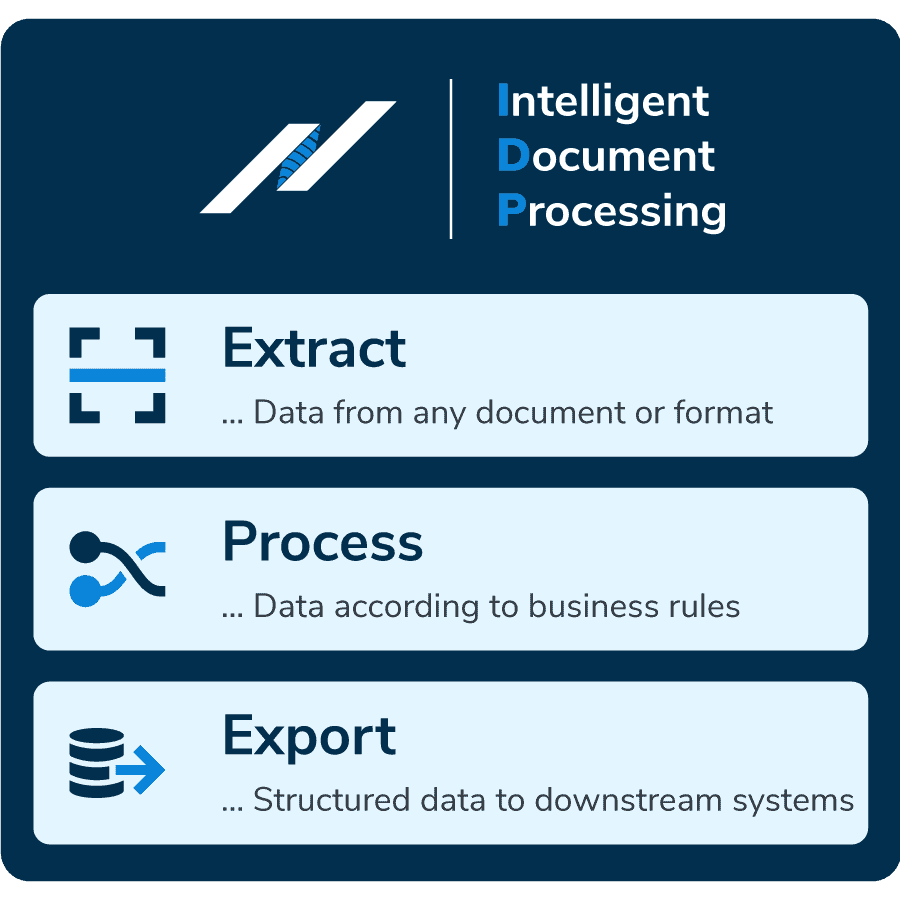
What are Intelligent Document Processing Solutions (IDP)?

Intelligent Document Processing (IDP) uses advanced optical character recognition (OCR)artificial intelligence (AI), and machine learning (ML) to automatically extract, interpret, and organise data from documents – driving more efficient business process automation.

Unlike traditional OCR, Intelligent Document Processing Solutions don’t just capture text; it understands context and meaning, enabling companies to handle complex, variable formats more accurately.

By continuing, you consent to being contacted by us. See Privacy Policy.

Netfira intelligent document processing overview image

Misconceptions of IDP

IDP is just advanced OCR

While OCR is a component of IDP, true IDP involves a comprehensive process including data extraction, interpretation, validation, and integration with business workflows. Some solution providers claim their OCR-based solutions are complete IDP, which oversimplifies and misrepresents the depth of genuine IDP capabilities.

IDP completely eliminates the need for human input

True IDP integrates a human-in-the-loop approach. It’s not about replacing human involvement but enhancing and assisting it, especially in complex decision-making and handling exceptions. Some solutions may overemphasise automation while downplaying the critical role of human oversight.

All IDP solutions offer equal capabilities

The market is varied, with some IDP solutions offering limited functionality focused mainly on data extraction. A full-fledged IDP solution, however, offers a broader range of capabilities including deep learning models for comprehensive document understanding and integration with a variety of business systems.

IDP is only suitable for large-scale enterprises

IDP is scalable and adaptable to businesses of all sizes. While some providers might target only large enterprises, true IDP should be accessible and beneficial to small and medium-sized businesses as well.

IDP implementation is overly complex and time-consuming

While IDP implementation involves a degree of complexity, especially in integrating with existing systems, it doesn’t have to be a lengthy or overly complex process. Some competitors might not provide sufficient support or customisable solutions, leading to this misconception.

Automate hours of manual processing

We understand every business has unique operational challenges – and we’re here to help you overcome them.

By continuing, you consent to being contacted by us. See Privacy Policy.

Benefits of IDP

reduce errors icon

Reduce errors

Minimise human error with our automated system, ensuring high data accuracy across all document processing tasks.

increase efficiency icon

Increase efficency

Maximise productivity with automated document processing, significantly reducing time spent on manual data entry.

dollar symbol

Cost savings

Experience substantial cost savings as the Netfira Platform reduces manual labour and increases operational efficiency.

workflow icon

Adaptability

Benefit from the Platform’s flexibility and customisable workflows tailored to meet your unique business requirements.

plug

Seamless integration

Integrate the Netfira Platform smoothly with your existing workflows and technologies, ensuring seamless operation.

scale icon

Scale with ease

The Platform is capable of handling high document volumes, supporting your business growth without the need for system overhauls.

IDP Frequently Asked Questions (FAQ)

What is Intelligent Document Processing (IDP)?

Intelligent Document Processing (IDP) uses AI, machine learning, and advanced OCR to extract, interpret, and organise data from documents. Unlike traditional OCR tools, IDP understands context and meaning, enabling end-to-end automation of workflows in various industries.

Basic Optical Character Recognition (OCR) converts images of text into digital text. IDP goes further by classifying data, validating its accuracy, and integrating with business systems. This holistic approach delivers more reliable, actionable insights.

Virtually any industry dealing with large document volumes can benefit. Common sectors include healthcare (claims processing), finance (invoice automation), logistics (shipping documents), and manufacturing (purchase orders). IDP reduces errors and speeds up processes in these areas.

No. While IDP automates repetitive, error-prone tasks, humans still play a critical “human-in-the-loop” role for complex decisions, regulatory compliance, and oversight. It’s about augmenting human capabilities, not eliminating them.
Key factors include ease of integration with ERPs or CRMs, advanced AI and ML capabilities for high accuracy, a scalable architecture, customisable workflows, and robust support or training. These features ensure a smooth implementation and long-term success.
Absolutely. Modern IDP platforms are often designed to be scalable, making them as beneficial for SMBs as for large enterprises. By automating document-intensive processes, smaller businesses can save costs, reduce manual workloads, and compete more effectively.
The implementation timeline depends on several factors, including the complexity of existing systems and the scope of the solution. However, an IDP solution can typically be implemented within a few weeks.
The IDP market is expanding rapidly as businesses embrace AI-driven automation. Ongoing developments in natural language processing, deep learning, and cloud-based services are driving broader adoption, making IDP a core element of digital transformation.

Explore further

Netfira-Webinar: IDP für Maschinenbau

Webinar recording: IDP for Mechanical Engineering

Access the recording of our latest webinar: Less manual work, more control - Intelligent Document Processing for mechanical engineering.
OCR and IDP

Why OCR Technology Fails on Real-World Documents – and How Intelligent Document Processing Can Help

For document processing, OCR alone struggles in real-world business environments. Read why Optical Character Recognition on a standalone basis can fail, and why an IDP solution can overcome these shortcomings.

A History of Document Automation 

From paper and fax to Intelligent Document Processing: Understanding how document processing and automation has evolved helps explain why modern approaches to document automation look the way they do today.

The Future of Document Automation: What to Look for in 2026

As AI matures, document automation is entering a new phase of digitalisation and automation. The conversation will move beyond OCR and focus instead on how AI enables business-ready document processing.